
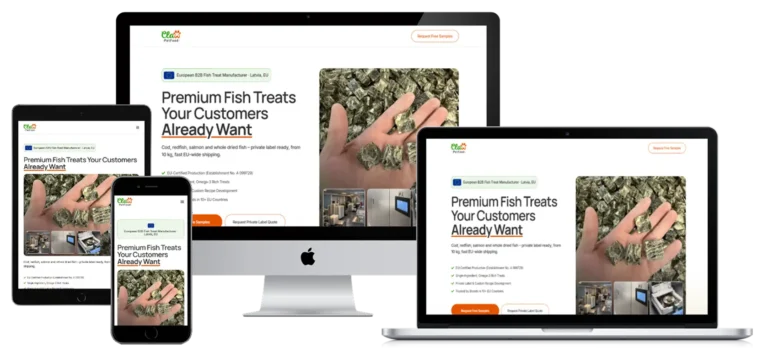
A Latvian manufacturer of fish treats for dogs and cats. It works on a private label model: European brands order products under their own label. The company had no online presence, and a buyer always checks out a supplier before sending the first email. We built an English-language website around what that buyer wants to know: certification, minimum order quantity, delivery times, traceability of every batch.
The result: organic inquiries roughly every three days from ChatGPT and Google almost immediately after launch. No ad spend.
12
The production line is running, the products exist, EU certificates are in place, yet the company has no online presence. For a B2B manufacturer, this isn’t a cosmetic problem.
Before writing to a supplier, a buyer at a European brand checks them out personally: is there a veterinary approval number, what’s the minimum order quantity, how long does delivery take, can samples be had without an NDA, can the facility handle the volume. If there’s nowhere to find the answers, the email simply never gets sent. There are other names on the supplier list.
We didn’t start with design but with a question: who opens this site, and what do they need to find out in the first minute?
We analyzed the audience: buyers at distributors, owners of small brands, product managers at retail chains. Each has their own doubts, but the set of questions is shared, and it became the framework of the page. Each section of the site addresses one specific objection instead of giving general information.
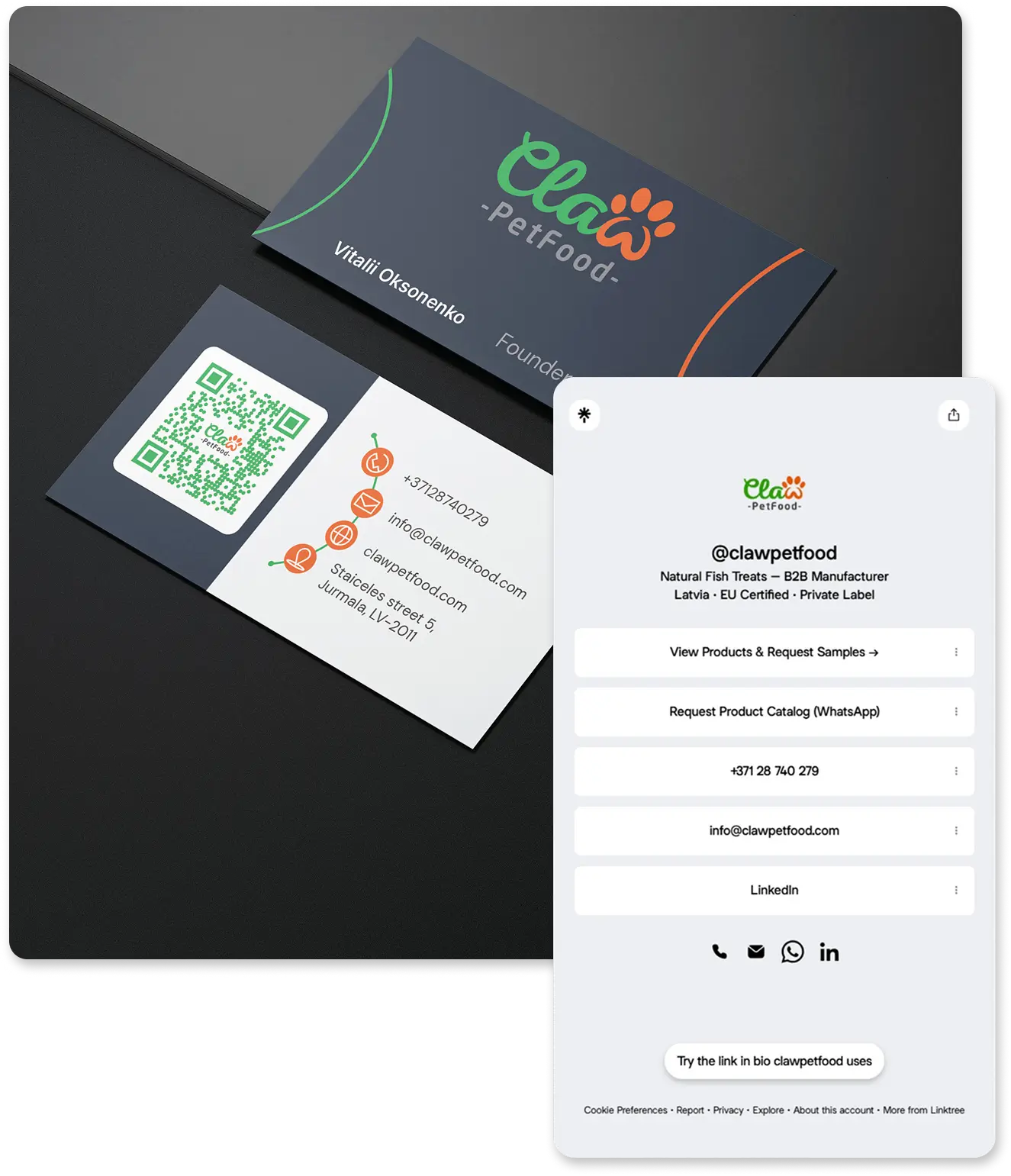
A website takes weeks, but the business card was needed urgently. We split the tasks: we created a QR code and a business card design, and pointed the code to a Linktree link page that we built and filled in ourselves, with WhatsApp, email and LinkedIn.
The same QR code went into the printed product catalog. A month later, when the website launched, a link to it was added to the page, and everything already printed kept working. Neither the business card nor the catalog had to be reprinted.
Analyzing the audience took several iterations: segments, their objections, competitors, positioning. One working version was assembled from several drafts.
The result was a 12-section copy prototype in English, where each section answers a specific buyer question. Only after the client approved the copy did the task go to the designer. The design was built around finished content, not the other way around.
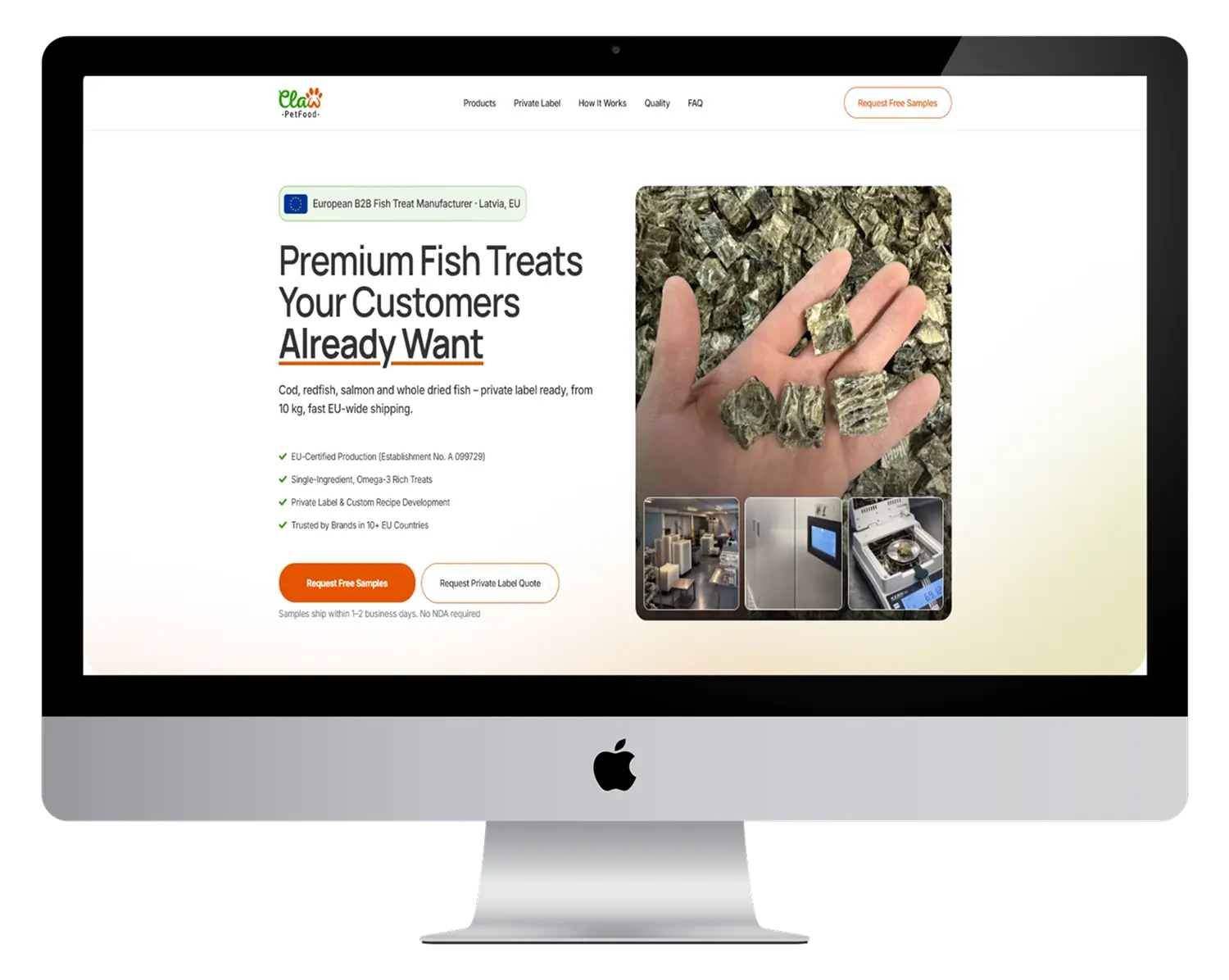
The four lines under the headline answer the four main questions a buyer asks a supplier: EU veterinary establishment number, single-ingredient composition, private label and recipe development, work with brands in ten European countries.
The line under the buttons removes the last barrier: samples ship within one or two business days, no NDA required. The visitor doesn’t need to scroll through the site to decide whether it’s worth writing.
Three reasons to choose this manufacturer are set out in a separate section, each backed by a number: EU delivery in 2–4 days with no customs, a separate 470 m² (5,060 sq ft) facility that processes only fish, a minimum order from 10 kg.
The last one is key for a small brand: it can test the product on real customers without tying up its budget. This removes a new partner’s biggest fear.

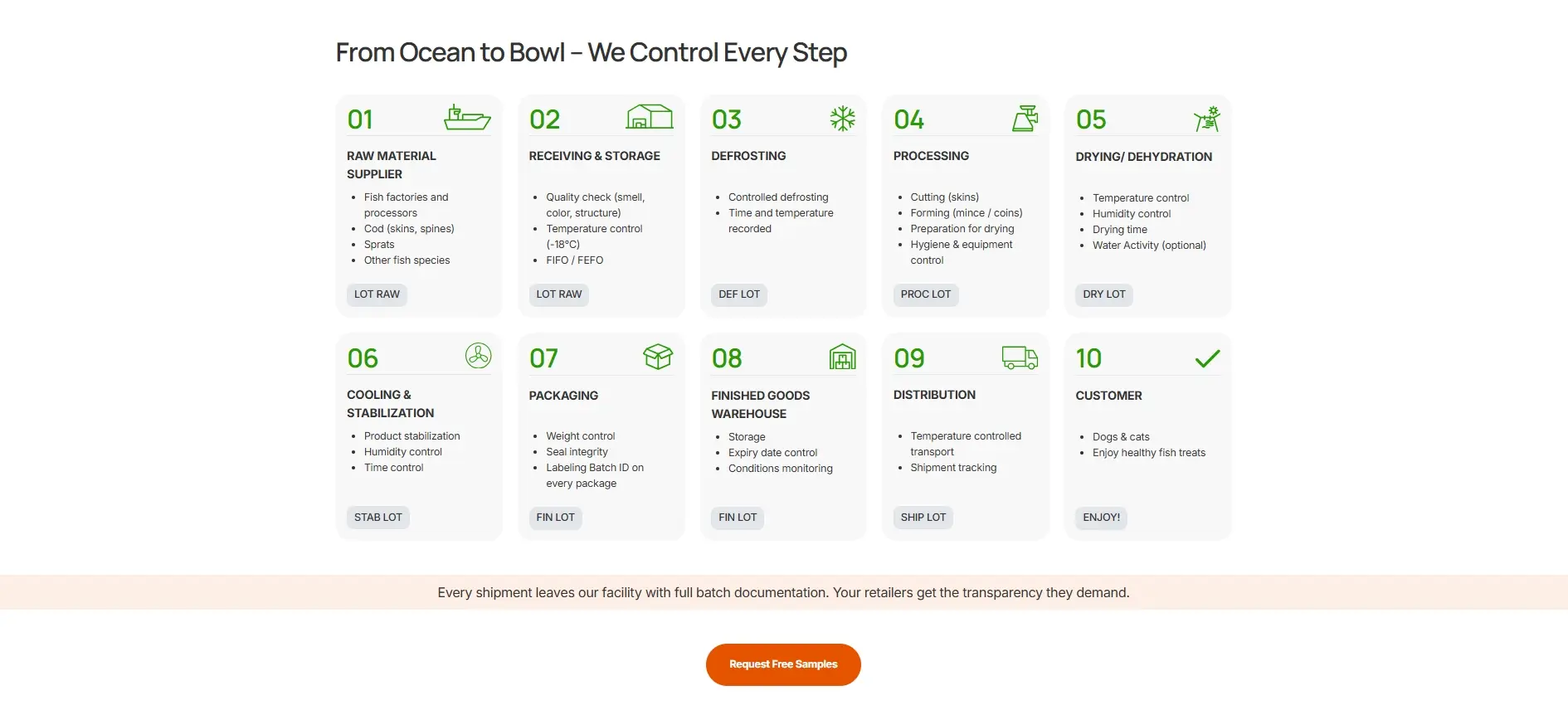
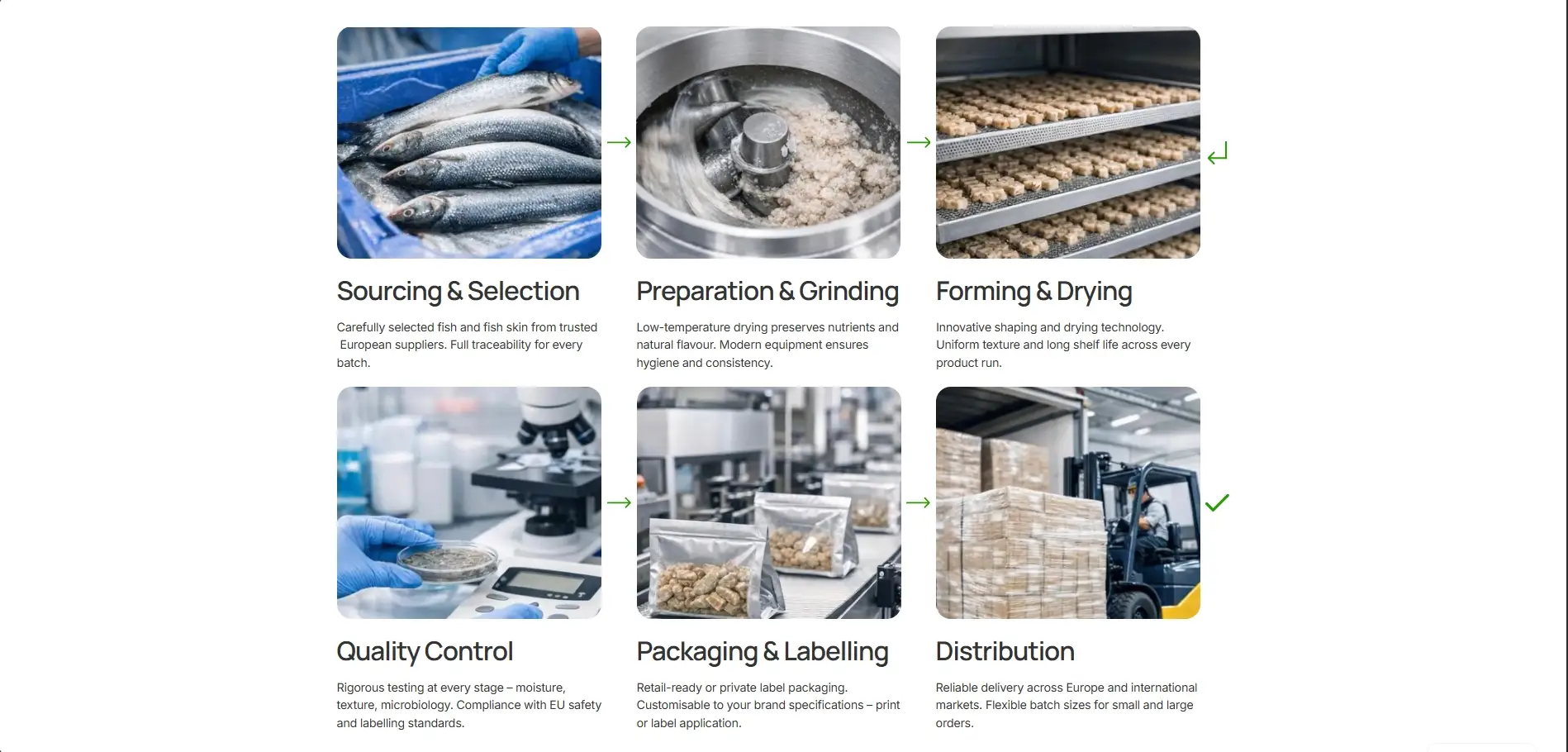
For retail chains, batch origin is a mandatory requirement. Instead of the phrase “full traceability,” the site shows a ten-step diagram from receiving and freezing raw materials to shipping, with the batch marked at every stage.
The buyer sees a process, not a reassurance, and can show this diagram to their retailer.
All images on the site are real: production halls, drying chambers, the lab, the warehouse, the products. The client provided photos from their facility, we edited them in Photoshop and built the design around them.
For a food manufacturer, this is essential: a stock image is recognized instantly and undermines trust exactly where it needs to be built.
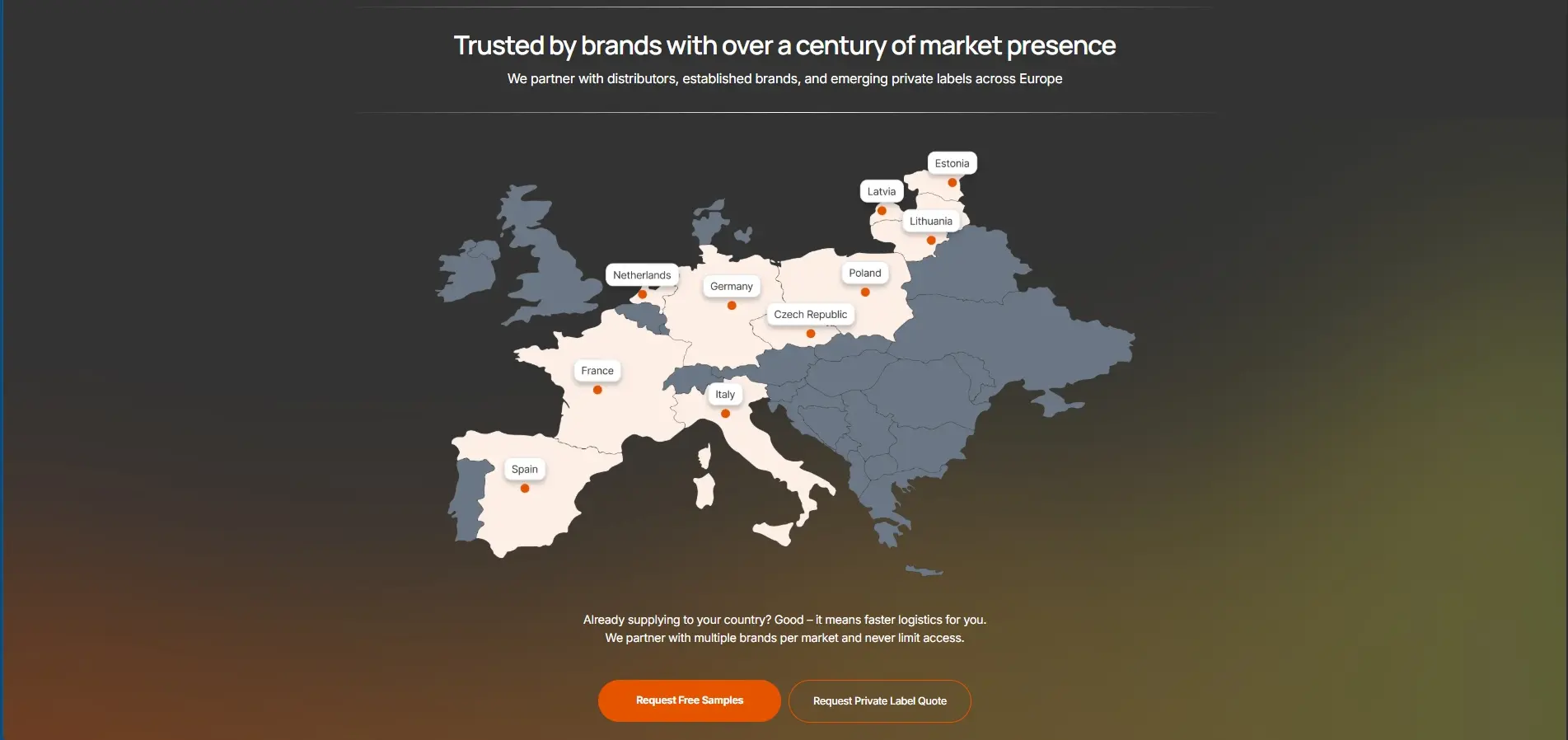
The countries the company supplies are shown on a map. The markers aren’t baked into the image: they remain separate elements.
When a new market appears, a marker can be added in a minute, without a designer and without redrawing. The map grows along with the client’s reach.
The client’s domain was with a third-party service, so we set up the DNS records there and launched the site at its working address. We bought hosting and set up SSL, email and SMTP so that inquiries arrive and don’t end up in spam.
We worked separately on speed: CDN, image compression, caching. The site is registered with search engines, marked up and open for indexing.
The site launched in July 2026. In the first two months, with no ad budget, 65 people found it through Google search and 62 through ChatGPT.
The second figure is a story of its own. The site is two months old, and the AI is already recommending the company as a supplier: almost one in five visitors comes from ChatGPT. That’s what a narrow specialization, honest facts and a technically clean website achieve together.
Inquiries come in steadily, on average one every three days. They come from real companies: the domains in their work email addresses lead to live websites of European pet food brands.
The work continues: the client chose not to manage the site themselves and kept it on the studio’s technical maintenance plan.
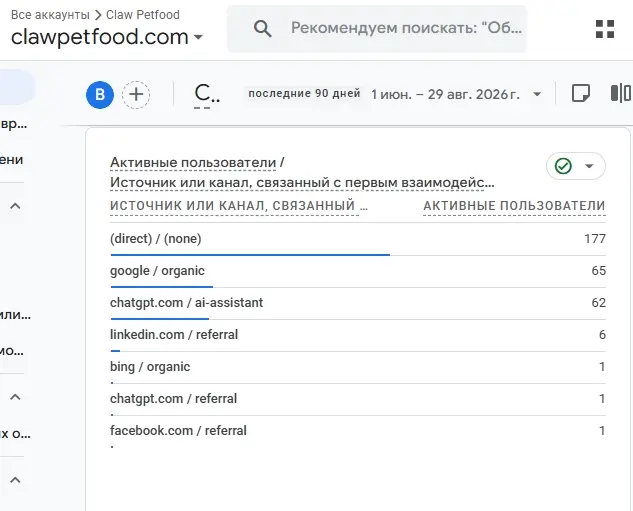
The site launched in July. This Analytics screenshot shows organic traffic from ChatGPT and Google in the first 2 months after launch.
If your product is ready but potential clients have nowhere to check you out, we know how to fix that.
Send us an inquiry: we’ll prepare a free design for the top section of your homepage and a project estimate. No obligation, no prepayment.
Or message us right now
We use cookies to improve your experience on our website. You can accept cookies or customize your preferences.
Fill out the form, and we’ll get in touch to clarify a few things about your company and the task, by call or by message, whichever suits you. Then:
There’s no obligation whatsoever.